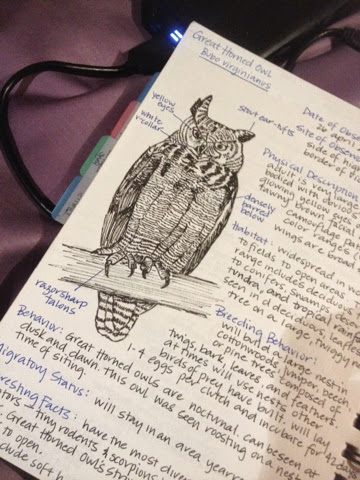
So this past week, we transitioned from Introduction to Field Science Teaching and completed our first week of Community Ecology in the Greater Yellowstone Ecosystem. This was a great course to experience: a review on ecological terms and get back into the scientific mindset, but also to challenge myself in the natural history of western flora and fauna!!! Joe, you would be proud, I was putting my Naturalist Certification to the test in my field notebook and journal!
On Monday, we learned about the Sagebrush area. We examined plants such as Mountain Big Sagebrush, Antelope Bitterbrush, and Oregon Grape (Creeping Mahonia). These plants all live on the valley floor where the xeric (glacial, alluvial wash) soil is arid and full of various percentages of loam, clay, and sand (depending on the plant).
 |
Mountain Big Sagebrush
Artemisia tridentata |
Mountain Big Sagebrush is a light-green, silver three-toothed leaved plant with fall-blooming small yellow composite flowers. It has two types of root systems: both shallow for quick, shallow water supplies, and a deep taproot system to obtain a more permanent resource. They have both ephemeral and evergreen leaves depending on the season and release a very strong aromatic scent. This leads to the fact they have a chemical defense system of terpenes which makes the plant taste bad when eaten. Many sage grouse, sage and brewer's sparrows, mormon crickets, gall midges, and agora moths utilize the Mountain Big Sagebrush.
 |
Oregon Grape
Mahonia repens |
|
|
Another plant that lives on the arid, valley floor is the Oregon Grape or also known as Creeping Mahonia. This low, wintergreen shrub has alternating, pinnately compound leaves that consist of 5-7 leaflets that are edged with spine-tipped teeth. They produce grape-like berries that are purple-bluish, but when squished have a sour taste, but if added with sugar does resemble grape juice. I learned that the Oregon Grape also has antibacterial qualities in the roots and that the leaves in tea can relieve stomach pain and serve for contraceptive purposes...what?!?!
 |
Quaking Aspen
Populus tremuloides |
 |
| Putting my drawing skills to the test - Quaking Aspen |
Tuesday was the discussion on Aspen Trees. This was one of my favorite days. Aspen are a favorite tree of mine - I just love their UV protected, white bark! So distinguishable! Did you also know that many aspen in a grove are practically the same plant since they all share the same root system! Did not know that! Besides the asexual reproduction through shoots from the same root system, given the right growing conditions, especially after a fire, aspen can reproduce sexually with the release of seeds. I like how these trees are called Quaking Aspen. Aspen will live in dry, moist foothills and colonize on slopes so they are constantly in the sun. In order to keep cool, the tree will help cool air around the leaves to reduce higher rates of evapotranspiration - by which the leaves have long stems and are able to move more freely in the wind, hence the trembling look!
 |
Common Snowberry
Symphoricarpos albus |
Common Snowberry lives among the same habitat as the Aspen. This deciduous shrub has opposite, slender hairless branches and produce a poisonous white, waxy berry-like drupe. Do not eat it - you will be in for a painful, sour stomach!
Wednesday was the day we learned about the confiers. So many conifers! Just to name a few, we explored the Lodge-Pole Pine, Douglas Fir, Subalpine Fir and the Engelmann Spruce. The Douglas Fir lives in the moist-dry foothills with flat evergreen-bluegreen needles and can be distinguished by the small little brown circles that reside at the attachments of the needles. Douglas Fir also has resin-blister bark, corky ridges, and vertical fissures. The Subalpine Fir is a little different, a shade tolerant evergreen that has fragrant, short, thick branches with spire-like crowns and gray-blistered bark that you can pop! Ew, I know! The needle on the subalpine have a slight twist at the base of the needle and have a suction cup-like attachment to the branches.
 |
Douglas Fir
Pseudotsuga menziesii |
 |
Subalpine Fir
Abies lasiocarpa |
This week really helped me learn about new flora to my natural history knowledge and definitely helped me get back in tune with my artistic side as well. I really missed drawing and am really thankful I can incorporate that talent back into everyday life again!
 |
| Re-connecting back with my artistic talents. :) |
 |
| Evidence of Beaver |
Thursday was the Riparian ecosystem day. This was really cool. We took a hike to Schwanbacher's Landing, went on a silent hike to a floodplain and observed whatever we could see in silence. Some of us saw beaver and birds, but it was just a nice experience to sit, listen, and watch the natural world in silence for a few minutes.
Here, we talked about the Blue Spruce, Narrowleaf Cottonwood, various Willows, and the River Continuum Concept, as well as interactions between beaver, moose, and other ungulates (hooved-animals) that utilize and play important roles in the riparian area.
 |
Narrow Leaf Cottonwood
Populus angustifolia |
Narrow-leaf Cottonwood is a river and stream plant of the riparian ecosystem that has slender, lanced-shaped leaves, with wedge-shaped bases. Their buds are sticky and aromatic.
 |
| Leah attempting to be a flexible beaver! |
On Friday, back in the classroom, we had a Western Plant Practical to identify, name, and scientifically name the species of plants we discussed out in the field. Totally aced that test! It was definitely due to the intensive sketches I did throughout the week and vigorously studying both the common and scientific names with key clues and hints all week-long!
 |
| Modeling & Rocking the 'Build a Beaver' Outfit! |
I really enjoyed the week of Community Ecology. 1.) because it was an outside, in the field all week class, 2.) because it helped me refresh and review what it is like to be back in the scientific field and use that mentality more often, 3.) it allowed me to challenge myself in new natural history I am not accustomed to and 4.) it helped me reconnect with a passion I do not get to partake in as much as I would like to.
Speaking of artistic ability, we have a Species Account due on Monday for a native species of the Greater Yellowstone Ecosystem. Of course, I chose the Pika!!! Moose was already taken! I guess you could tell I had a load of fun with this assignment: Pikas and drawing! Boom!
 |
| My Species Account on the Pika! |
This upcoming week, we are back to Introduction to Field Science Teaching and prepping for our Fall Teaching Practicum and our first opportunities at teaching Teton 5th that are here this week! Super excited to finally be working with children!!!!!! About time!
Until then,
TheChristyBel