This evening I went to Cary Institute for a one of their events, "Why Should We Care About Nature?," presented by Harry W. Greene. Below is the event description that the Cary Institute provided. But let me just say, he is a phenomenal speaker and I am so excited I was able to meet him. Also, he called me a fellow teacher naturalist!
Join the Cary Institute for a special lecture by herpetologist Harry Greene, who will discuss his book,Tracks and Shadows: Field Biology as Art. Through an exploration of frogs, snakes, African megafauna and other charismatic wildlife, Greene will reveal how natural history, aesthetics, and ethics underpin conservation.
Greene’s research concerns the behavior, ecology, evolution, and conservation biology of vertebrates. Most of his work has taken place in Latin America and the U.S. - Mexico borderlands, tackling questions such as the origin of the rattle, factors controlling local and regional species richness, and ways that science enhances nature appreciation.
He has written some 200 publications, including Snakes: the Evolution of Mystery in Nature, which won a PEN Literary Award and made the New York Times’ annual list of 100 Most Notable Books. His latest book, Tracks and Shadows: Field Biology as Art, is both an autobiography and a celebration of beauty in nature. Frances Bonier of Science writes, “Greene engages readers from beginning to end. The book leaves us with questions to ponder but also with inspiration to indulge our curiosity for nature.”
Before becoming a Professor of Ecology and Evolutionary Biology at Cornell University, Greene was a Professor and Curator in the Museum of Vertebrate Zoology at the University of California, Berkeley. He holds a Ph.D. from the University of Tennessee, a Master of Arts degree from the University of Texas, and served as a medic in the U.S. Army.
His honors include Berkeley’s Distinguished Teaching Award, the Edward O. Wilson Naturalist Award, and a Stephen H. Weiss Presidential Fellowship. Greene was named a fellow of the American Association for the Advancement of Science and California Academy of Sciences and served as president of the American Society of Ichthyologists and Herpetologists.Business Insider named him one of Cornell’s “Top Ten Professors.”
Showing posts with label Naturalist News. Show all posts
Friday, September 30, 2016
Tuesday, July 19, 2016
Species Spotlight: Trumpet Vine
Trumpet Vine or Trumpet Creeper
Lives In: Trumpet Vine are fairly drought tolerant, however, can be found on trees of moist woods, along fences, in residential gardens and along house sides.
Niche: The large, bright orange and red flowers attract a wide array of pollinators. The Ruby Throated Hummingbird is a common visitor to its flowers.
Threats: It is an aggressive growing plant; its rapid colonization is caused by its aerial roots that are able to cling onto any surface. It can grow dense and be a nuisance in gardens and out compete other plants.
Frequency: Trumpet
Vine is a common plant in the Shawangunks near residential areas, fences, and
roadsides.
Reproduction: Flowers will bloom in early summer through September. By fall, fruit develops in the form of pods that reach up to 6 inches in length.
Fun Fact: Another name for Trumpet vine is Devil’s Shoestring, as this plant has invasive qualities and can be a nuisance at trying to remove.
Tuesday, June 28, 2016
Invasion of the Milkweed Beetles
Red Milkweed Beetle
Looks Like: A member of the Cerambycidae family (the
Longhorn Beetle family), the Tetraopes
tetrophthamlus is a vibrant reddish-orange beetle. While its head, thorax
shell, and abdomen outer shell are vibrant reddish-orange, its legs and
undersides are dark brown to black. Its outer shell can be slightly speckled
with little black spots and splotches. It also has very dark brown to black
long curled antennae on the top of its head.
![]() |
| These beetles have taken over and eaten many of the Common Milkweed plants, which has prevented them from blooming their flowers. I am curious to see if we get any Milkweed seed pods this fall. |
Lives In: They can
be found in any habitat where their host (the Milkweed plant) will grow – in
gardens, grasslands, fields, meadows, and along roadsides.
Niche: Red Milkweed Beetles will eat all parts of milkweed and dogbane plants – the leaves, the buds, and the flowers.
Threats: As these beetles show off their aposematic (warning) colors, they warn predators that they are inedible with their red and black colors. It is thought that these beetles are inedible as they incorporate the milkweed toxins that the plant emits into their bodies.
Frequency: This
is a very common beetle species as long as its host plant is present.
Reproduction: In early summer, females will lay her eggs at the base of or in milkweed stems. When the larvae hatch, they will migrate to the roots by tunneling their way down just under the surface of the stem or burrowing down through the soil. They may remain at the roots over winter, feed in the spring, then pupate. About a month later, the larvae will emerge from their pupa as an adult.
Fun Fact: Red Milkweed Beetles vocalizes a squeaking shrill by rubbing surfaces of its segments on its thorax (middle part of its body).
Friday, May 27, 2016
Pink Lady Slippers
Pink Lady Slippers
Looks Like: A large, showy wildflower of the Orchid Family. It has two opposite basal leaves and a large flower at the end of an erect stalk. The flower can be magenta to white-pink. The plant can grow 6-15” in height.
![]() |
| First Emergence on the Preserve - May 12 |
Lives In: A variety of habitats and can be found in hardwood, coniferous forests of pine and hemlock. They also can be found on rocky and mossy slopes (similar to much of the habitat found on the Shawangunk Ridge). Pink Lady Slippers prefer to grow in areas of disturbance in these forests.
Niche: In order to survive and reproduce, the Pink Lady Slipper needs to interact with a fungus in the soil in order to grow and bees in order to reproduce. The Orchid seeds do not have food supplies inside them like most seeds. The Pink Lady Slipper seeds require the threads of fungus to break open the seed and attach them to it. Once attached the fugue will pass on food and nutrients for growth and survival. When the plant is able to produce most of its own food, the fugue will extract nutrients from the orchid roots – a symbiotic or mutually beneficial relationship occurs. Pink Lady Slippers have closed flowers and only certain animals can enter and exit the small opening in the front. The bee is tricked into thinking the orchid holds nectar due to a sweet-smelling aroma the flower expels. As the bee tries to exit the flower, it gets covered in the flower’s pollen. If the bee gets tricked by another Pink Lady Slipper, it will deliver pollen from the first flower and help with the start of reproduction.
Also, White-Tailed Deer love this plant as a food source.
Threats: Pink Lady Slippers can be found in the Shawangunk woodland areas, however, they take a very long time to grow. Picking these flowers is not recommended.
Frequency: They are a common wildflower in the Shawangunks.
Reproduction: Flowers in early to Mid-May into July.
Fun Fact: Another common name for the Pink Lady Slipper is the Moccasin Flower as the flower looks like a shoe. The roots were used as a remedy for nervousness, tooth pain, and muscle spasms.
![]() |
| And on a RARE occasion, you get a double Pink Lady Slipper! Found by one of my volunteers, this was an amazing find! They look like a pair of Ballet Shoes! |
Friday, May 20, 2016
American Kestrel Banding
![]() |
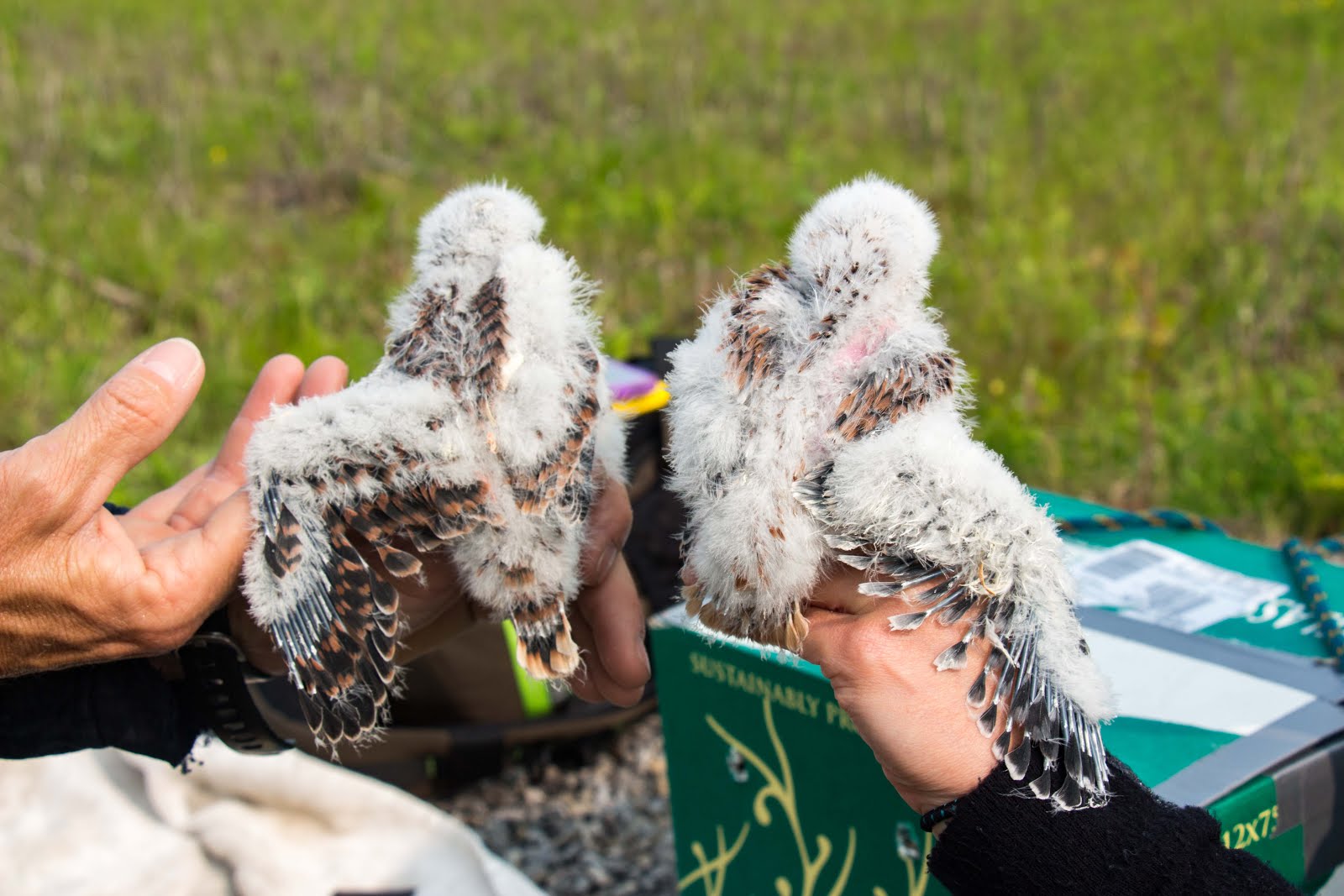
| Mohonk Preserve, Research Associate, Zach Smith retrieving the chicks from the Kestrel Box. |
![]() |
| In the Shawangunks Grassland Kestrel Box, Zach retrieved 6 chicks (4 females and 2 males) |
American Kestrel
![]() |
| Weighing Each Chick - They Were Not Happy |
Lives In: These tiny falcons prefer open grasslands, meadows, and deserts. As you drive on roads, you can commonly find American Kestrels perched on telephone wires in search for prey.
![]() |
| Wahhhh! They were really not happy! |
Threats: Breeding habitat has declined for Kestrels due to thinning and clearing of land and standing dead trees. In addition to breeding habitat declination, the American Kestrel population is declining due to the loss hunting habitat. “Clean” farming practices such as the removal of unwanted hedges, trees, bushes, etc. reduce shelter for prey sources.
![]() |
| Measuring the tarsus |
Reproduction: American Kestrels do not build their own nests. They will nest in pre-existing holes or cavities in trees that were made by other birds or use nest boxes that have been built by humans. Kestrels will use the same territory to nest in year after year. During courtship, the pair will perform aerial displays, a series of sequential dives in the air. The female will create a nest called a “scrape.” A scrape is a small depression in the substrate on the floor of the cavity or nest box. The female can lay up to four to six eggs in a clutch. The eggs will be incubated for about 30 days predominantly by the female while the male hunts and brings in food. When the eggs hatch, they are tiny balls of white down and fluff. After two weeks once hatched, the chicks begin to develop their flight feathers and the symbolic colors of an adult Kestrel. They will begin to fledge 30 days after hatching.
![]() |
| Female (left), Male (right) Females are pretty rufous on entire wing, Males have a blue, gray slate color wing |
TheChristyBel
![]() |
| Getting to Hold a Baby Kestrel My Life was Complete! |
Monday, May 9, 2016
Jefferson Salamander
Looks Like: Dark brown to gray body with a lighter underside. Blue-gray speckles are on the limbs and lower sides of the body. Jefferson Salamanders can be 4.25” to 8.25” in length. They have a wide snout, a long and slender body. And a tail that almost extends the length of the body.
Niche: Jefferson Salamanders’ diet includes worms, insects, snails, and slugs. This species is often prey for owls, snakes, striped skunks, and raccoons.
Threats: In dry spring times, many young Jefferson Salamander in temporary vernal pools can die before they mature enough to leave the pool before it dries up. As their pond dries and the water level declines they also become more vulnerable to predators. With climate change, the wide fluctuation in the occurrence and amount of precipitation during spring and summer and lack of snow cover in winter can pose major risks for this salamander’s survival. Acidic rain at breeding time can cause embryonic mortality. Loss of small unregulated wetlands is also a major threat.
Frequency: These salamanders are rare to find except for breeding nights in late winter and early spring. An average lifespan of Jefferson Salamanders is three years.
Reproduction: Jefferson Salamanders will breed in woodland, vernal pools. They will emerge on rainy nights and migrate to pools when the ground is partially thawed and ice still on pools. When the males and females locate each other (by chemical communication), the males will entice the females with snout rubbing, clasping, and synchronized swimming and tail waving. The female will pick up the male’s released spermatophores in her cloaca and will lay up to 250 eggs in small clusters a few days later. The egg masses are tubular and clear, attached to twigs and soft vegetation. Eggs will hatch 4-6 weeks later and the larvae will complete development after 2-4 months.
Fun Fact: The Jefferson Salamander is involved in a hybrid complex with three other species of salamanders – the Blue-Spotted Salamander, the Small-Mouth Salamander, and the Tiger Salamander.
Northern Red Salamanders
Northern Red Salamander
![]() |
| This was a very special find, as we do not see them very often! |
Looks Like: Northern Red Salamanders can be 4-7” in length. Their stout body is red to reddish-orange with dotted to irregular, rounded black spots all over its back and limbs. They have five toes on their hindlimbs and four toes on forelimbs. They have 16-17 costal grooves (grooves along its underside).
Lives In: Terrestrial and aquatic environments. They prefer to under fallen bark, logs, and rocks in woodlands and under leaf litter in cool streams.
Niche: Northern Red Salamanders are prey to woodland birds, skunks, and raccoons. These salamanders are carnivorous and will feed upon insects, worms, other invertebrates, and sometimes smaller salamanders.
Threats: These salamanders depend on intact deciduous forests to survive. Their survival can be compromised with encroaching development that devastates and removes forest habitats.
Frequency: Northern Red Salamanders are uncommon in the Shawangunks. It is a very special treat to come across one on a hike. Northern Red Salamanders can live more than 20 years.
Reproduction: Males will rub their snout on the female’s head and chin. Once the female is enticed, she will collect the male’s spermatophores with her cloaca. Her egg location is cryptic – she’ll lay her eggs in springs, brooks, and under streambanks. The egg masses are gelatinous in a single stalk. The 30-130 eggs she lays will hatch in early winter and remain in larval stage for 1-3 years before becoming an adult.
Fun Fact: Northern Red Salamanders have a projectile tongue that can extend and return in 11 milliseconds. They can also release a toxin from their poison glands to repel away certain predators.
Northern Slimy Salamander
Looks Like: Slimy Salamanders are mostly black with abundant silver-white specks all over its body. It is also has a present nasolabial groove. The Slimy Salamander gets its name from the slimy, glue-like substance that is secreted from its skin glands.
Lives In: Under stones, rotting logs, in woodlands and along streams. They often moves underground through animal and insect burrows.
Niche: Slimy Salamanders will feed on ants, beetles, sowbugs, and earthworms.
Threats: The Slimy Salamander is neither considered threatened nor endangered throughout its range.
Frequency: This species of salamander is common throughout the Shawangunks in moist, woodland areas.
Reproduction: Males will attract females by performing an elaborate dance. Males during breeding season develop pink to red spots on their chin and feet. During the beginning of April, eggs are deposited in moist areas such as caves, under rocks, and rotting logs. Three months after the female lays eggs, the juveniles will emerge. The juveniles do not experience an aquatic stage like other salamanders do and will directly develop into adulthood.
Fun Fact: Slimy Salamanders were once considered one species, but recently, have been split into 13 separate species. They all look very similar to each other, but are best differentiated by range.
Thursday, May 5, 2016
Afternoon Walk at Spring Farm
Friday, April 1, 2016
April Fools at the Preserve
Tuesday, March 29, 2016
Spotted Salamander & Giant Water Bugs
Right now, I am prepping and gathering live pond specimens for the Preserve's Spring Pond Keepers season. Besides purchasing a bunch of craft materials and cleaning all the pond equipment, I have to go out into the field and collect pond creatures. I have a special Department of Environmental Conservation license to macro invertebrates and amphibians to place into ponds that will be housed in elementary classrooms for up to 10-days.
My collections areas include all waterways of the Preserve, Louisa Pond, and Humpo Marsh. It's a good thing I purchased my own waders last summer, because right now, the creatures are scarce. It's still pretty much in winter-mode still and many of the creatures are deeper in the water. And...I am pretty glad I purchased the neoprene waders. Kathy, my Director of Education, urged me not to get those. But since I am collecting not just in the fall when it is still relatively warm, I am collecting in winter, and they keep me nice and toasty!! I'm a smart cookie for thinking that one up! Just kidding!
I think one of my favorite parts of the job is definitely being out in the field - with students, with research associates, other staff, or even just myself. I think every time I am out of the land, I end up finding something special. This morning while I was out, I scooped up some Spotted Salamander eggs (do not worry, I placed them back!) and two large Giant Water Bugs (these will be great for a Creature Feature or special guest when I come to the classrooms). Check out the pics below!
TheChristyBel
Lives In: Adults prefer deciduous bottomland forests along moist areas such as rivers. At times they can be found in conifer forests as long as the soil is damp. In mountainous regions, like the Shawangunks, they are frequently found in deciduous slope forests.
My collections areas include all waterways of the Preserve, Louisa Pond, and Humpo Marsh. It's a good thing I purchased my own waders last summer, because right now, the creatures are scarce. It's still pretty much in winter-mode still and many of the creatures are deeper in the water. And...I am pretty glad I purchased the neoprene waders. Kathy, my Director of Education, urged me not to get those. But since I am collecting not just in the fall when it is still relatively warm, I am collecting in winter, and they keep me nice and toasty!! I'm a smart cookie for thinking that one up! Just kidding!
I think one of my favorite parts of the job is definitely being out in the field - with students, with research associates, other staff, or even just myself. I think every time I am out of the land, I end up finding something special. This morning while I was out, I scooped up some Spotted Salamander eggs (do not worry, I placed them back!) and two large Giant Water Bugs (these will be great for a Creature Feature or special guest when I come to the classrooms). Check out the pics below!
TheChristyBel
Spotted Salamander
Looks Like: Spotted Salamanders have stout, black to dark-brown bodies, a broadly rounded snout, large and strong legs with four to five toes on each foot. The underbelly is a pale, slate gray, the mid-dorsal lines of the body have up to 24 to 45 large, round, yellow or orange spots in two irregular rows running from head to tail.
| Spotted Salamander Eggs |
Niche: Adult Spotted Salamanders are rarely seen since they spend most of their time hiding in leaf litter, under decomposing logs, or in tunnels below ground. These animals may help with control of insect pests such as mosquitoes that breed in their vernal pools or ponds.
Threats: In dry spring times, many young Spotted Salamanders in temporary vernal pools can die before they mature enough to leave the pool before it dries up. As their pond dries and the water level declines they also become more vulnerable to predators. With climate change, the wide fluctuation in the occurrence and amount of precipitation during spring and summer and lack of snow cover in winter can pose major risks for Spotted Salamander's survival. Acidic rain at breeding time can cause embryonic mortality. Loss of small unregulated wetlands is also a major threat.
Frequency: The Spotted Salamander is a fairly common species on the forest floor. They can serve as prey for skunks, raccoons, turtles, and snakes. Their eggs are also prey for frog tadpoles, crayfish, and other macroinvertebrates. Red-spotted Newts have been seen feeding on the egg mass jelly.
Reproduction: During the spring breeding season, adults migrate to ponds and vernal pools to lay their eggs in fish-free, fresh water (usually starting their migration during the first foggy rain during the thaw of snow). Males produce blobs of sperm (spermatophores) allowing the female to take the spermatophores into her body to fertilize her eggs. Females will lay compact firm egg masses that are attached to submerged objects. A female can lay between 100-300 eggs per year. The eggs are encased in a protective thick, clear, or milky jelly. Spotted Salamander larvae are a dull, greenish color when hatched.
Fun Fact: Spotted Salamanders have poison glands in their skin located on their backs and tails. When the salamander is in danger or threatened, their glands release a sticky, white, toxic liquid.
| Large Giant Water Bugs Also known as "Toe-Biters." They definitely pack one painful pinch! |
Subscribe to:
Posts (Atom)