 |
| Happy Holidays from the DSRC! (The Wreath was Purchased, but I Decorated It) |
Showing posts with label Daniel Smiley Research Center. Show all posts
Showing posts with label Daniel Smiley Research Center. Show all posts
Tuesday, December 13, 2016
Happy Holidays From the DSRC

Friday, October 14, 2016
Mohonk Red American Witchhazel
 |
| While my parents were in a tour of the DSRC Archive Room with Paul, I discovered the Mohonk Red American Witchhazel in bloom! Super Pretty! |
Saturday, July 30, 2016
A Lake Brain Break
It's really nice working up at the Daniel Smiley Research Center on really hot days during the summer. If I need a brain break or I head into work early, I can walk up to the Mountain House and show my staff ID to go swim on the list! I really love Mohonk Lake. It is one of the most amazing lakes to swim in - great temperatures, clear and clean water, and just an amazing lake! If you're ever in the area, you definitely need to check out this lake!
TheChristyBel
 |
| A 15-Minute Walk From My Office & I Am Soaking Up Rays |
Thursday, July 21, 2016
Squirrel!
During some field work, Paul, Bryan, and I were in the field and totally stumbled upon a really cool find - we observed a melanistic Gray Squirrel. Melanistic, meaning all black, is a development of dark-colored pigment in the skin or appendages of an animal. It is the opposite of albinism. This was definitely a rare sighting on the Ridge!
TheChristyBel
 |
| A Really Cool Find in the Field Today! |
Friday, March 25, 2016
Hudson Valley Weather Visits the DSRC
Every month, I tabulate the weather records and formalize it into a summary for distribution to the public. Amanda, the Media Associate, posts all of our weather summaries online and shares them on social media. When she posted our February weather summary, it sparked the attention of Hudson Valley Weather. For those of you who do not know, they are the "MountainWeather.com" of the Hudson Valley. They are more reliable than the Weather Channel. Pretty impressive. Majority of the locals of New Paltz swear by Hudson Valley Weather. They have told me that even though this organization started out as a hobby for a bunch of businessmen and engineers, they have been predicting the weather of the region more accurately than the Weather Channel. So, back to sparking their attention. They were so stunned that we had a weather station at Mohonk and wanted to close in on some partnerships with using our data and having access to our summaries. So with that, they wanted to meet us. I felt more like a fan than the celebrity when they met us. We talked about what the Daniel Smiley Research Center does, the history of the weather station and data collection, many of our research projects, and of course, brought them up to the lake and weather box. It was a super great meeting and introduction to each other! Hopefully we will develop some closer ties and able to use each other as we continue the focus on Climate Change.
TheChristyBel
 |
| We made their blog! |
 |
| Daniel Smiley Research Center Staff Meet Hudson Valley Weather Staff Weather Nerds All Around! |
Friday, March 11, 2016
Vernal Pool Monitoring
March is the month of vernal pool monitoring. Many amphibians are coming out of hibernation and kicking it into breeding season. Recently, our North Mud Pond has been getting a lot of frog action and we have been seeing a lot of Wood Frogs! Super exciting!
TheChristyBel
 Looks Like: The Wood Frog has a flat body, moist skin, a pointed head, and webbed feet with un-webbed distal toe joints. Coming a variety of shades of brown and red, Wood Frogs have a black marking over their eyes resembling a robber’s mask. Their coloration is greatly influenced by their surroundings; during mating seasons the females have a lighter red complexion where the males are much darker brown.
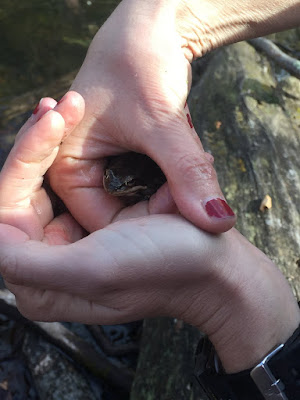 Reproduction: One of the first frog’s to begin the breeding season, the Wood Frog will move to breeding pools usually in a melt or rainwater typically free of fish or other predators. The males will call to females; their calls sound like a “duck-like, quack.” When a attracted, larger female enters the pool, the smaller male will grab onto her back (called “amplexus”). Squeezing her abdomen, the eggs will be released into the water and the male will release sperm into the water to fertilize the egg mass. An egg mass usually contains 1,000 to 2,000 eggs. The egg mass will accumulate together in the shallows of the pools into a raft. Counting the egg mass rafts is a highly efficient way for scientists and researchers to determine population density of the Wood Frog in a given region or area.

TheChristyBel
 |
| One of the First Coltsfoot Blooms of the Season |
Wood Frog
 Looks Like: The Wood Frog has a flat body, moist skin, a pointed head, and webbed feet with un-webbed distal toe joints. Coming a variety of shades of brown and red, Wood Frogs have a black marking over their eyes resembling a robber’s mask. Their coloration is greatly influenced by their surroundings; during mating seasons the females have a lighter red complexion where the males are much darker brown.
Lives On: Tundra, wet grasslands, and moist woodlands are most favored by Wood Frogs. The Wood Frog uses pools formed by spring rains and snow melt for breeding. Once breeding is over, adults will spend the rest of their season away from water.
Niche: A variety of snakes, waterfowl, heron, raccoon, coyote, and fox have been seen feeding on Wood Frog. The Wood Frog tadpoles fall prey to beetles, giant water bugs, salamanders, turtles, and other frogs.
Threats: Wood Frogs , along with all amphibians, are under ecological pressures due to human activities. Through reforestation, road building, agriculture, and industry development, the Wood Frog's habitat is slowly diminishing. In addition to loss of habitat, acid rain and other forms of air pollution can contaminate breeding pools and seriously damage the adults, eggs, and offspring. Researchers studying the Wood Frog must also take special care in cleaning their equipment and clothing gear in fear of spreading ranaviruses that can kill the frog and other amphibians.
Frequency: This frog is found in 2/3 of the country into Canada and the Arctic Circle. Many of the Wood Frog in the Shawangunks can be found in vernal pools, marshes, and moist woodlands in the Foothills to the Ridge.
 Reproduction: One of the first frog’s to begin the breeding season, the Wood Frog will move to breeding pools usually in a melt or rainwater typically free of fish or other predators. The males will call to females; their calls sound like a “duck-like, quack.” When a attracted, larger female enters the pool, the smaller male will grab onto her back (called “amplexus”). Squeezing her abdomen, the eggs will be released into the water and the male will release sperm into the water to fertilize the egg mass. An egg mass usually contains 1,000 to 2,000 eggs. The egg mass will accumulate together in the shallows of the pools into a raft. Counting the egg mass rafts is a highly efficient way for scientists and researchers to determine population density of the Wood Frog in a given region or area.
Fun Fact: Wood frogs, along with several other frogs, undergo a freeze-thaw cycle. Unlike some animals that migrate elsewhere, grow thick fur, or burrow deep underground to sleep over the winter waiting for spring, the Wood Frog seeks cover under leaves and actually freeze and thaw with their surroundings. They stop breathing and their hearts cease to beat. The Wood Frog has a special antifreeze that prevents ice from forming in their cells. At the same time, the Wood Frog’s liver starts making large amounts of glucose (type of sugar) that packs into the cells and props them up. When the weather warms, the Wood Frog will thaw and begin to go about their lives. The Wood Frog is unharmed during this freeze-thaw cycle.
Monday, March 7, 2016
First Emergence
Even though our winter season has been quite mild (and has felt like spring), seeing some of the first signs of spring really makes it feel like spring more. Working at the Daniel Smiley Research Center today, I was walking into the house and discovered a few little blooms in our front garden, Winter Aconite and Snow Drops. I even got a little more excited when I heard some buzzing on the yellow blooms and found some honeybees! Spring is definitely springing up and I am ready for some warm(er) weather!
TheChristyBel
 |
| Winter Aconite - First Bloom |
 |
| First Honey Bee |
 |
| First Snow Drop |
Saturday, February 27, 2016
Peregrine Watch
Seasonal change is about to occur in the next few weeks. The temperature is going to (hopefully) get warmer, plants will begin to sprout leaves and flowers, mammals will be emerging out of their burrows, and birds will be migrating back and starting to breed. Many of these phenological events that spring has to offer are scientifically studied by the Mohonk Preserve. We have our Phenology Project that observes specific plants throughout the year, we monitory lake profile health daily, we count breeding birds and vernal pool breeding, and monitor raptors during fall migration and breeding on the cliff. Most of these projects are led by me, but we rely on a handful of volunteers for each project. Today, we hosted our Peregrine Watch citizen science program where we have three eyrie (nest) locations along the Shawangunk cliffs where Peregrine Falcon pairs breed. This orientation that we had today was introducing volunteers to the project of Peregrine Breeding Observation, showing them where the eyrie locations are (the general regions), and identifying the types of breeding practices that the raptors go through during the season. We have three known locations on the Ridge where Peregrine pairs have been known to make home for their eyrie: one on the Near Trapps, one on the West Trapps (where most of our climbing happens), and one on Bonticou Crag. Volunteers are asked to come out daily or a couple times during the week and observe the peregrines. They record what they are seeing on the day of their observation, like: copulation, nesting or incubating (there is a lack of bird presence, but some solo bird flying to and from the eyrie), prey exchanges, sightings of chicks, fledging, and young in flight. Our goal is to monitor these birds closely and gather an estimate date throughout the breeding season of when these stages will usually occur. The Peregrine Falcon was pretty much brought to extinction in the Gunks due to DDT useage. They were introduced back int he 1970s and have been closely monitored. We monitor our Falcons to make sure their population is thriving and how we can manage our land and recreational protocols (cliff closures, trail closures, etc) to encourage population growth and stability. Feel free to check out more about Peregrine Watch here (along with many of our other birds programs).
Cheers to a great Peregrine Season!
TheChristyBel
 |
| Ted & Sami Viewing Peregrine Activity on the West Trapps |
 |
| Viewing the West Trapps |
 |
| See that White Dot - that is a Peregrine! |
 |
| A Little White Dot - A Peregrine! |
 |
| A Side Profile of Bonticou Crag for another Eyrie |
Thursday, February 25, 2016
A DSRC Tour for the SMAN Junior Rangers
So far during this new job, I have been teaching programs that have already been brainstormed and written up. Today, I was able to create a whole new program for Education that revolved around the Daniel Smiley Research Center. Since I work in two different departments, I was chosen to lead the San Miguel Academy's 8th graders in a Daniel Smiley Research Center-based program.
If I have not already explained this, the Daniel Smiley Research Center is where the Conservation Science department is housed. The DSRC is home to our collections room where Daniel Smiley kept specimens of flora and fauna that were discovered on the ridge, even archaeological, Native American artifacts found in rock shelters on the ridge, and it houses over 120-years of weather, lake, and natural history records.
Originally, this program was planned to have a snow-shoe hike around the Mountain House property. However, we have not been getting much snow to make snow-shoeing possible. So, we had to put on the "flexi-pants" and come up with something else. I decided to do a rendition of the Murie Museum back in the Tetons.
I created a workbook/DSRC journal that focused on up to 8 activities that allowed the students to float through stations for about an hour. These activities portrayed similar activities that our staff and research associates perform at the DSRC. So, it was basically a "Day in the Life of the DSRC" tour. Below are some of the stations I created.
TheChristyBel
 |
| Station 1: Bird Identification Using Specimens, Guides, & Observation |
 |
| Does this plant have alternating or opposing leaves? |
 |
| Station 2: Understanding the Herbarium |
 |
| Identifying Birds |
 |
| Station 3: Mammal Identification Through Skull Anatomy Station 4: Examination of Native American Artifacts (in the background) |
 |
| Herbivore, Carnivore, Omnivore? |
 |
| Station 5: Measuring Precipitation from the night before |
 |
| Station 9: Visiting Mohonk Lake to Obtain Lake Samples |
Friday, February 12, 2016
Chilly Morning
Temperatures here in the Gunks are not as frigid as they are back west. I think we have only gone below 0 degrees a handfull of times, but it has been really cold here. The humidity really plays a role in how cold the east is - it's bone-chilling cold! I am not sure if I like it.
But as I look from my office window at the Daniel Smiley Research Center, the ice crystals are just so beauitful and makes me really appreciate being inside and admiring the cold and winter from a warm room.
TheChristyBel
 |
| It's a Bit Chilly Outside |
Tuesday, February 9, 2016
Snowy Morning at the Mountain House
Photos from my morning on the lake
 |
| My Snowy Morning on the Boat Wharf |
 |
| Little Pano of Mohonk Lake and the Mountain House |
Subscribe to:
Comments (Atom)