During our last week of Place-Based Education, the graduates were able to gain a more in-depth understanding of the place we live in. On Wednesday, we visited Mormon Row, right up the street from the Kelly Campus. Even though it was very chilly, rainy weather to walk in, it was a great opportunity to learn more about the culture and history that roamed the sageflats years ago.
For those of you who do not know where Mormon Row is, if you drive north from Jackson on highway 191
past Moose Junction and turn right onto Antelope Flats Road, you can follow the
road about 1 ½ miles until you see a north-south running dirt road
marked by a distinctive pink stucco house on the left with a small dirt
parking area.
Mormon Row may be one the most picturesque areas of Grand Teton National
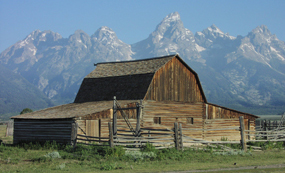
Park. The groups of old farm buildings have rustic, wooden buildings surrounded by open fields, grass
and sage standing out against the stunning backdrop of the Tetons. This historic place is a great way for seeing into the lives
of the West’s early settlers and can be commonly seen with grazing wildlife right up to the walls of the original structures. A great place to
find bison, antelope, moose, coyotes, ground squirrels, northern
harriers, kestrels and sage grouse.
Here is the back story: The leaders of The Church of Jesus Christ of Latter-day Saints, or
Mormons, sent parties from the Salt Lake Valley to establish new
communities and support their expanding population. Arriving in the 1890s from Idaho, these old farm buildings have withstood the
elements for more than a century, since the farmland here was first
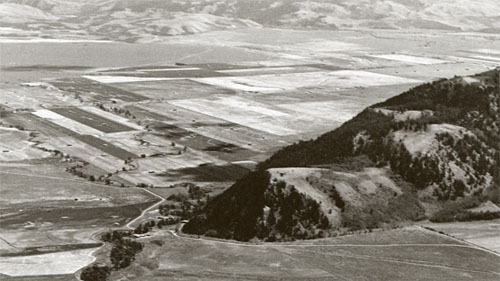
homesteaded by the predominantly Mormon settlers in the early 1900s. The Mormon homesteaders, settled east of Blacktail Butte and clustered their farms to share labor and community, a stark contrast
with the isolation typical of many western homesteads.
These settlers established 27 homesteads in the Grovont area because of
relatively fertile soil, shelter from winds by Blacktail Butte and
access to the Gros Ventre River. Despite the harsh conditions of Jackson
Hole, Mormon settlers grew crops by using irrigation. These hardy
settlers dug ditches by hand and with teams of horses, building an
intricate network of levees and dikes to funnel water from central
ditches to their fields between 1896 and 1937. Water still flows in some
of these ditches.
After the Rockefellers Snake River Land Company bought the majority of
the land and transferred it to the Park Service, the buildings were
allowed to decay until the 1990s, when their cultural value was
recognized and steps were taken to preserve them. Today, six homesteads
and a single ruin provide visitors a glimpse into the past of Jackson
Hole Valley.
 |
Aerial photo of Blacktail Butte and Mormon Row
Courtesy of Jackson Hole Historical Society and Museum, 1991.3991.001
http://www.nps.gov/grte/historyculture/mormon.htm |
 |
John Moulton Barn
Courtesy of Jackson Hole Historical Society and Museum, 1991.3991.001
http://www.nps.gov/grte/historyculture/mormon.htm |
Today, two picturesque barns highlight Mormon Row. Settlers John and
Thomas Alma (T.A.) Moulton built these barns on adjacent homesteads.
After nearly 30 years of working the land, John replaced his log home
and barn with a new carpenter-constructed, pink stucco frame house and
impressive, two-story gambrel barn north of Antelope Flats Road. South
of John’s homestead, T. A. took over 30 years to build his
gable-with-shed style barn. Photographers from around the world stop by
T. A. Moulton’s barn to capture this iconic historic structure with the
Teton Range in the background.
 |
| Andy Chamber's Residence |
The most extensive historic complex remaining on Mormon Row is the Andy
Chambers homestead. Andy Chambers claimed land in 1912 and secured the
title under the Homestead Act by building a log cabin and stable and
clearing ground to grow grain, a backbreaking chore in the rocky soil.
The family lacked running water until 1927 and harnessed electricity
with a windmill in 1946. The Rural Electric Administration did not
provide power to Mormon Row until the 1950s. By this time, many families
had sold their homesteads to become part of the park. The windmill
still stands on the homestead.
Of course, it would not be complete without seeing some wildlife tracks! I suspect we have coyote wandering the area! However, we did not see any, the tracks looked pretty fresh and were probably there earlier that morning before we arrived to Mormon Row.
 |
| Coyote Tracks |
 |
| Almost the Size of My Palm |
Historically Fulfilling!
TheChristyBel